
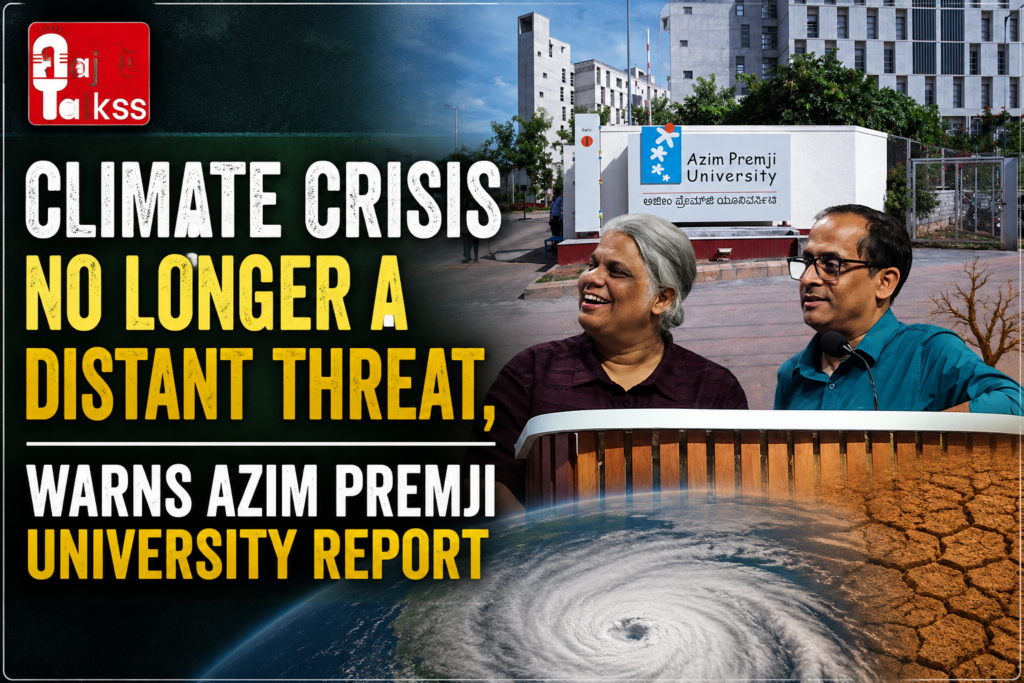

Kolkata, June 19: India’s 11,000-km coastline is set to face severe climate challenges over the next 15 years, with rising temperatures, erratic rainfall, sea-level rise and stronger cyclones posing immediate threats to millions of people, according to a new report released by Azim Premji University, Bengaluru.
Titled “Indian Coastal Region: Climate Projections 2021–2040,” the report presents high-resolution (25×25 km) district-level climate projections, comparing expected conditions during 2021–2040 with the climatic baseline of the 1960s. The study employs the latest CMIP6 climate models, corrected for regional bias, to provide locally relevant data for policymakers and disaster management authorities.
The report warns that India is rapidly approaching the 1.5°C global warming threshold, leaving a narrow window for adaptation and resilience-building.
“Climate change is not some distant future challenge—it is the reality of today. 2040 is just 14 years away,” said Anurag Behar, CEO of the Azim Premji Foundation. He said the report highlights the urgent need to redesign infrastructure, governance and development planning to cope with accelerating climate risks.
According to Harini Nagendra, Director of the School of Climate Change and Sustainability at Azim Premji University, climate change has become a hyper-local crisis affecting everyday life across India’s coastline.
“Our findings show that whether it is heat stress in Ernakulam or rising salinity in the Sundarbans, climate vulnerability is already visible. We must move from reactive mitigation to proactive adaptation,” she said.
West Bengal Under Growing Climate Stress
The report identifies South 24 Parganas and Purba Medinipur among the districts expected to undergo significant environmental changes by 2040. Summer maximum temperatures are projected to increase by around 1°C, while the Northeast monsoon could intensify by up to 11 percent in Purba Medinipur.
The Sundarbans continue to face increasing threats from repeated embankment breaches, leading to groundwater salinity that is affecting agriculture, drinking water and public health. The report also links rising salinity with higher incidences of skin diseases and menstrual health problems among women.
At the same time, women-led mangrove restoration initiatives are emerging as an important community-driven adaptation strategy, helping reduce coastal erosion and strengthen the fragile delta ecosystem.
Key National Findings
The report projects that India’s average temperature will rise by 1.5°C, with nearly 40 coastal districts expected to witness summer temperature increases exceeding 1°C.
Among the most vulnerable regions, Ernakulam is projected to record the highest increase in maximum summer temperature at 1.3°C, while coastal Kerala and Tamil Nadu are expected to experience dangerous wet-bulb temperatures approaching 31°C, posing serious health risks.
The study also forecasts significantly heavier monsoon rainfall across coastal Maharashtra and Gujarat, with suburban Mumbai likely to experience almost an additional week of heavy rain. Surat alone could witness a 23 percent increase in Southwest Monsoon rainfall.
Under the moderate-emissions SSP2-4.5 scenario, global sea levels are projected to rise by approximately 15 centimetres by 2050, accelerating coastal erosion and threatening to create “ghost villages” in vulnerable areas such as Ganjam in Odisha.
Rising sea-surface temperatures—currently increasing by 0.27°C per decade—are also expected to increase the intensity of tropical cyclones.
Traditional livelihoods are already being affected. In Goa, unseasonal rainfall is damaging salt production, while warming seas are pushing fish farther offshore, reducing catches for small-scale fishermen.
The report concludes that although climate impacts are becoming unavoidable, timely adaptation based on district-level scientific data can significantly reduce future losses and help safeguard India’s coastal communities.
Established under state legislations in Karnataka, Madhya Pradesh and Jharkhand, Azim Premji University operates as a fully philanthropic institution supported by the Azim Premji Foundation, with a focus on building a just, equitable and sustainable society.